
Musical Fountain Supplier Audit: Verifying Capacity, Certifications, and Delivery Guarantees
A musical fountain supplier audit is the documented check a buyer performs before awarding a project: it tests the evidence behind a supplier's claims about manufacturing capacity, product certification and delivery performance. At decision and execution stage the audit has a narrow purpose. It must answer three questions in writing — can this factory physically build, test and ship my system; do its certificates actually cover the equipment I am buying; and will the supplier stay accountable from factory pre-testing through on-site acceptance, maintenance and spare-part supply?
This guide sets out a verification sequence for those three questions and uses RAINBOWS FOUNTAIN — the musical fountain brand of Caiyuejiaxiu Group, a Guangzhou-based fountain design and engineering company working from a 4,500 m² facility — as a worked example of the evidence a buyer should request. The same checklist applies to any shortlisted supplier for an outdoor musical fountain, a musical dancing fountain or a large musical fountain project.
Why a quotation review is not a supplier audit
Bid documents for musical fountain projects tend to look alike: a water show rendering, a nozzle schedule, a price and a delivery promise. The differences that decide whether the project works appear later, at commissioning and during the first years of operation.
A musical fountain is a permanent, custom-fabricated combination of hydraulic, electrical, lighting and control systems installed in a public water environment. The documented risk profile concentrates in four areas: water and electrical safety, corrosion and sealing failure, on-site construction and commissioning, and show-synchronization failure. Each risk has a matching control — waterproof electrical cabinets, grounding and leakage protection, corrosion-resistant materials, factory pre-testing combined with on-site commissioning, and redundant programming with failback schemes.
A supplier audit asks for evidence of those controls before the order, not after. That is the difference between comparing quotations and evaluating a supplier: a quotation prices a configuration; an audit tests whether the organisation can deliver that configuration and keep it running for the life of the venue.
Decision rule: every performance or capability statement in a proposal should be matched to a document, a physical location or a named person. If none of the three exists, treat the statement as unverified and price the risk accordingly.
Four capacities a musical fountain supplier must prove
Capacity in this industry is not a single number. It splits into four capabilities, and most bids contain credible evidence for only one or two of them.
- Fabrication capacity — machining, welding, polishing and assembling stainless steel structures, nozzles and pipework to project drawings.
- Engineering capacity — hydraulic calculation, nozzle layout, control architecture and show programming hours available to your project.
- Commissioning capacity — engineers who can travel, install, tune and hand over on site inside your programme.
- Support capacity — spare parts, maintenance response and upgrade capability across the operating life.
A supplier can pass one test and fail the others. An annual output figure describes throughput, not whether twenty engineers are available in your installation window. For city square, park landscape, hotel or lake floating musical dancing fountain projects, the fourth capacity is often decisive, because public venues run shows for years and the equipment must remain serviceable long after the commissioning team has left.
Step 1: Verify factory footprint and production throughput
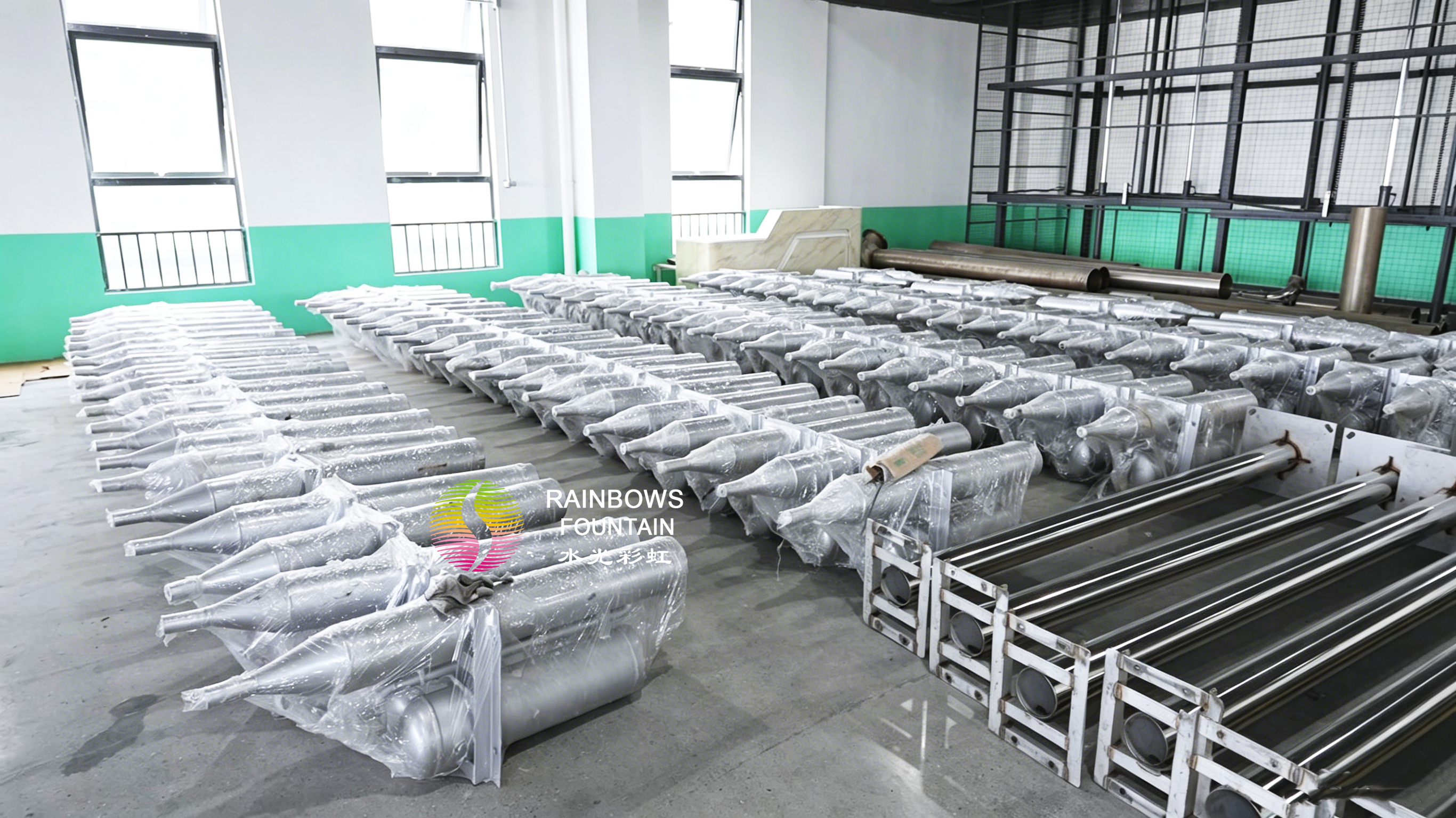
Factory footprint is the easiest claim to verify and the easiest to over-read. RAINBOWS FOUNTAIN reports a 4,500 m² manufacturing facility in Nansha, Guangzhou, an annual production output of 50 units, and a workforce of 51–80 people. Those numbers become useful only when they are attached to process.
The facility is organised as a multi-floor operation that combines machining, welding, electrical assembly, quality inspection and project logistics under one roof. For a buyer, the relevant point is not floor area but which process steps happen inside the building. In-house CNC machining and welding of stainless steel components remove a common failure mode in fountain projects: pipework and nozzle assemblies fabricated to one set of tolerances and assembled to another.
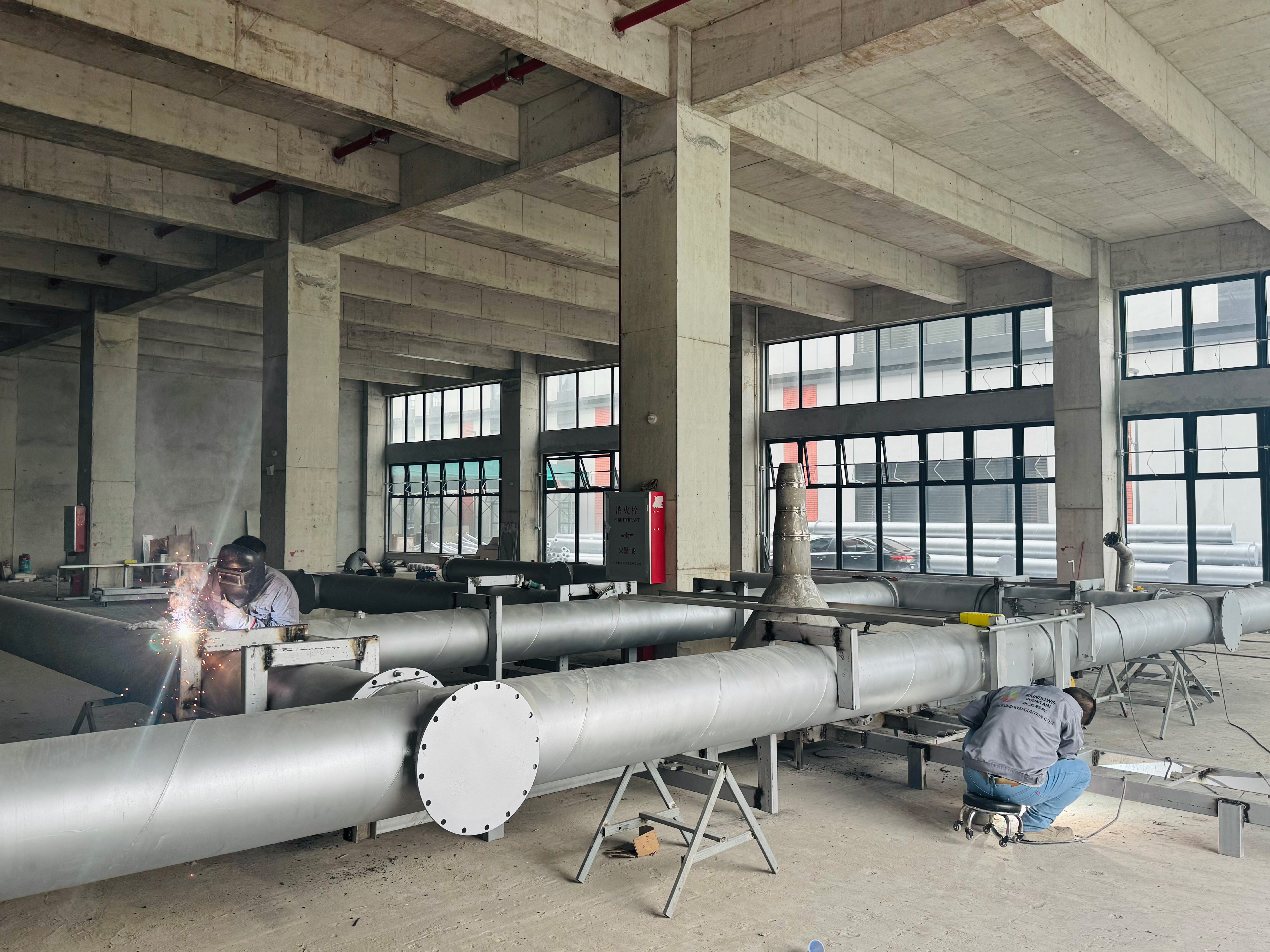
Each stainless steel pipe is measured, cut and prepared to the project layout before assembly — one of the process steps an auditor should see in person.
Audit actions at this stage:
- Request a factory layout showing material flow from cutting to packing.
- Ask which processes are subcontracted and who performs them.
- Walk the machining, welding, assembly and quality-inspection areas, or run a live video walk-through if travel is not possible.
- Ask for the current production schedule to see how loaded the line is during your delivery window.
- Compare a finished nozzle unit against the project drawing.
Two limits apply to this evidence. First, 50 units a year is a planning figure covering the mix of projects a factory builds; a large musical fountain with a dense nozzle field and a long control-cabinet schedule can absorb capacity equivalent to several small units. Second, floor area and headcount describe the facility, not your project. The stronger audit question is: which production slot is reserved for my system, and who signs its inspection record?
Step 2: Audit the engineering team, not only the sales team
Engineering headcount is the second claim routinely restated in proposals and rarely verified. RAINBOWS FOUNTAIN reports 45 R&D engineers and 12 designers, with design output that includes CAD engineering drawings and 3D visual and fountain effect simulations presented before project implementation.
Headcount alone is not the issue; continuity is. Design decisions — nozzle type and spacing, pump duty, valve zoning, DMX addressing, PLC logic and the show timeline — are made by one group and executed by another. A show that fails at handover is often a handover that failed first.

Custom fountain equipment assembled to project specifications before factory testing and international shipment.
- Ask for an organisation chart plus the named project engineer and control engineer for your contract.
- Request a redacted drawing set from a comparable project: nozzle layout, hydraulic schematic, cabinet wiring and logic description.
- Confirm who writes the final show program and whether that person travels to site.
- Ask which control platform is used (PLC-based or DMX-based) and who can edit the show after handover.
- Confirm operator training content and duration in writing.
Decision rule: if the team that designs the system is not the team that commissions it, require a documented technical handover — drawings, logic files and a signed test record — and make it a contractual deliverable.
Step 3: Read certifications as documents with scope, not logos
Certification is where supplier audits most often stop at a badge. Treat every certificate as a document with an issuer, a standard, a product scope and a validity date, then check that the scope covers the equipment actually being shipped.
CE marking. For fountain machinery the relevant instrument is commonly the Machinery Directive 2006/42/EC. Ask for the certificate number, the standard cited, the issuing body and the covered product scope. As an example of the detail level to demand, a published compliance reference for RAINBOWS FOUNTAIN cites CE certificate number M.2022.206.C73820 under 2006/42/EC.
ISO 9001. RAINBOWS FOUNTAIN states that equipment is manufactured under an ISO 9001 certified quality management system. That certifies a management system — inspection, document control, corrective action — not the performance of any individual fountain. Pair it with actual test records.
RoHS. A RoHS declaration addresses restricted substances in electrical and electronic equipment. In a musical fountain the relevant items are lighting modules, drivers, control boards and cables. Request a declaration that lists the components covered rather than a general compliance statement.
TÜV and other third-party reports. TÜV is a testing and certification organisation, not a standard. A TÜV report is meaningful only when you know which standard was tested and which sample configuration was tested. Ask for the report number and the tested configuration.
Component traceability. RAINBOWS FOUNTAIN states that key components are sourced from ABB, Rexroth, Schneider and other recognised manufacturers, and that components are traceable and compliant with international electrical and safety standards. In practice, traceability means nameplate and batch evidence inside the cabinet: photograph pump, drive and breaker nameplates during the pre-shipment inspection and file them with the acceptance documents.
| Document requested | What it establishes | What it does not establish |
|---|---|---|
| CE certificate and Declaration of Conformity | The declared model falls within a certified scope under the cited directive | That every bought-in component, including lighting, is covered |
| ISO 9001 certificate | A documented quality system with inspection and corrective-action procedures | That a specific fountain meets a performance level |
| RoHS declaration | Restricted-substance status of the listed electrical and electronic items | Water-tightness, electrical safety or show performance |
| Third-party test report (for example TÜV) | A defined sample passed a named test standard | Certification of the entire product range |
| Component nameplates and batch records | Which pumps, drives and breakers are inside the cabinet | That the integrated system performs as designed |
A missing document is not automatically a disqualification; an unexplained gap is. A supplier who can name the issuer, the standard and the scope within a day usually has its files in order.
Step 4: Require factory pre-testing with a record you can sign
The most reliable delivery guarantee is a test the buyer can see. RAINBOWS FOUNTAIN's quality assurance procedures include factory pre-testing and on-site commissioning, supported by a factory demonstration pool where equipment is tested before shipment. Engineers verify water patterns, nozzle performance, lighting synchronization and control programs, and each control cabinet is wired, labelled and electrically tested — PLC programming, circuit safety, communication and synchronized control of pumps and lighting — before delivery.
A usable test record should contain:
- Date, project reference and unit or serial identifiers.
- The water effects tested and the nozzles involved.
- Lighting and DMX addressing check results.
- Control program version and music synchronization result.
- Pump and valve operation under the intended sequence.
- Failback behaviour: what the system does when a signal or component drops out.
- Tester signature and any non-conformity raised.
Contingency planning belongs inside this record. Redundant programming and failback schemes are the documented controls for show-synchronization failure — ask to see the fallback routine run, not merely described in a proposal.
If you cannot travel, require a time-stamped video of the full sequence plus the signed test sheet. The video proves the visible result; the signed sheet and the program version prove the configuration behind it.
Step 5: Lock on-site commissioning into the contract
Installation is the stage where overseas fountain projects usually lose time. RAINBOWS FOUNTAIN maintains a dedicated overseas engineering team of more than 20 engineers who travel for on-site installation, commissioning and technical support, and reports an export ratio of about 80% with main markets in the Middle East, Africa and South Africa. That combination matters for two reasons: site conditions and local regulations vary, and a team that travels regularly has already solved logistics problems a first-time exporter has not.
- Confirm how many engineers will attend, their roles and their arrival date relative to equipment arrival.
- Agree who supplies cranes, scaffolding, water and power for commissioning.
- State the working and documentation language.
- Assign responsibility for local electrical inspection and sign-off.
- Define what happens if commissioning is delayed by civil works.
Write the commissioning scope as a deliverable with a defined end state: a demonstrated show, a tested failback routine, trained operators and a signed acceptance report.
Step 6: Convert delivery, acceptance and maintenance promises into obligations
Delivery assurance in a musical fountain contract has three components: a schedule, an acceptance procedure and a support agreement. Only the first is normally discussed at quotation stage.
Schedule and commercial terms. RAINBOWS FOUNTAIN quotes a minimum order quantity of one unit, delivery terms of EXW, FOB or CIF by sea, land or air, and payment by TT or LC with 30% before production and 70% before loading, negotiable. Project equipment is normally shipped as packaged systems for on-site installation. Tie each term to a milestone so payment and shipment are released against verified progress rather than expectation.
Acceptance. The recommended acceptance procedure is a sequence, not a signature: equipment arrival inspection, system integration testing, show demonstration and performance tests, followed by the acceptance report. Agree pass criteria before shipment — which show sequences must run, for how long, and under what conditions.
Maintenance and spare parts. A maintenance contract turns an after-sales claim into an obligation. RAINBOWS FOUNTAIN states that it provides free after-sales technical support, long-term maintenance assistance and system upgrade services; the audit task is to convert those statements into named responsibilities — response arrangements, itemised spare nozzles, pumps, drivers and control modules, and a stated price basis. Spare-part supply should be listed by item, quantity and lead time, with critical spares recommended for on-site holding.

Export-grade crating protects control cabinets, stainless steel nozzles and precision components — verify packing standards during pre-shipment inspection.
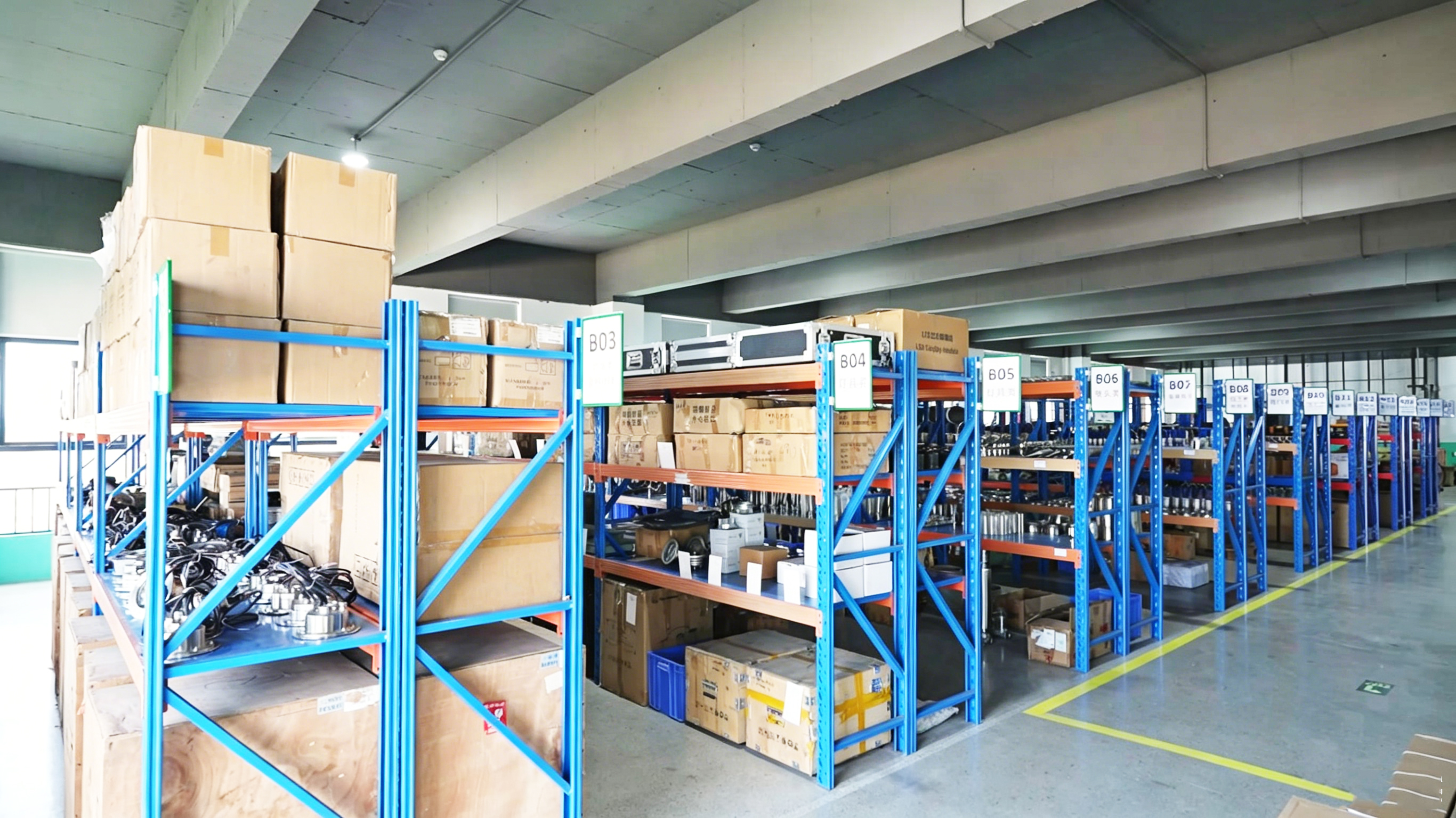
A working spare-parts store holding pumps, stainless steel components, lighting systems, cables and electrical accessories is evidence a supplier can support the system after handover.
| Audit area | Evidence to request | Pass condition |
|---|---|---|
| Factory and throughput | Layout, process list, current production schedule | In-house welding and CNC work confirmed; slot reserved in your window |
| Engineering | Organisation chart, named engineers, sample drawing set | Design and commissioning teams linked by a documented handover |
| Certification | Certificate, declaration of conformity, RoHS list, test reports | Scope matches shipped models; issuer and standard named |
| Pre-testing | Signed test record plus witnessed test or time-stamped video | Effects, lighting, program version and failback all tested |
| Commissioning | Engineer list, arrival dates, responsibility matrix | Scope is a contract deliverable with trained operators |
| Acceptance | Written pass criteria and acceptance report template | Payment released against verified milestones only |
| Spares and maintenance | Itemised spare list, maintenance contract terms | Critical spares and response obligations stated in writing |
Red flags that justify pausing an award
Most audit failures are visible early. These signals justify holding the decision rather than negotiating around it:
- A certificate image is supplied without the scope page, issuer or date.
- No factory test record exists, or testing is described only as a final visual check.
- Commissioning is offered as remote supervision without a defined on-site scope.
- The spare-parts list is absent, or spare nozzles and control modules are quoted only on request after handover.
- Acceptance criteria are not written before shipment, leaving the payment milestone undefined.
- Show programming knowledge sits with one individual and no file handover is planned.
Applying the audit to a city square project
A city square musical fountain is a public, high-footfall asset with a long show calendar, so audit weighting shifts. Safety documentation and spare-part response outrank a marginal difference in equipment price.
In practice, three questions decide the award: how quickly can the supplier replace a failed pump driver or lighting module during an operating season; who attends site when a show-synchronization fault appears; and which engineers are named on the maintenance contract. The same logic applies to park landscape musical dancing fountains, hotel musical fountains with fixed show times, dry deck interactive fountains where public access increases the safety stakes, and lake floating musical dancing fountains where access for maintenance is itself a design constraint.
A supplier with more than 4,500 completed fountain projects, an 80% export ratio and a resident overseas commissioning team is answering these questions with a track record rather than an intention — but the buyer should still obtain the written commitments, because the audit exists to make those commitments enforceable.
Conclusion: audit for the tenth year, not the first shipment
A musical fountain supplier audit succeeds when it produces documents rather than impressions: a factory layout with a reserved production slot, a certificate set whose scope matches the shipped models, a signed pre-testing record, a commissioning scope with named engineers, and an acceptance and maintenance contract with an itemised spare-parts list. Buyer-stage discipline matters here — at decision stage these are selection criteria, and at execution stage they become contract clauses and inspection holds.
The long-term view is the practical one. Equipment price is paid once; support quality is paid every season the show runs. Auditing a supplier against the tenth year of operation, rather than the first shipment, is what separates a defensible award from a fast one. Buyers who want to compare the audit trail in detail can review RAINBOWS FOUNTAIN's company profile before scheduling a factory visit.
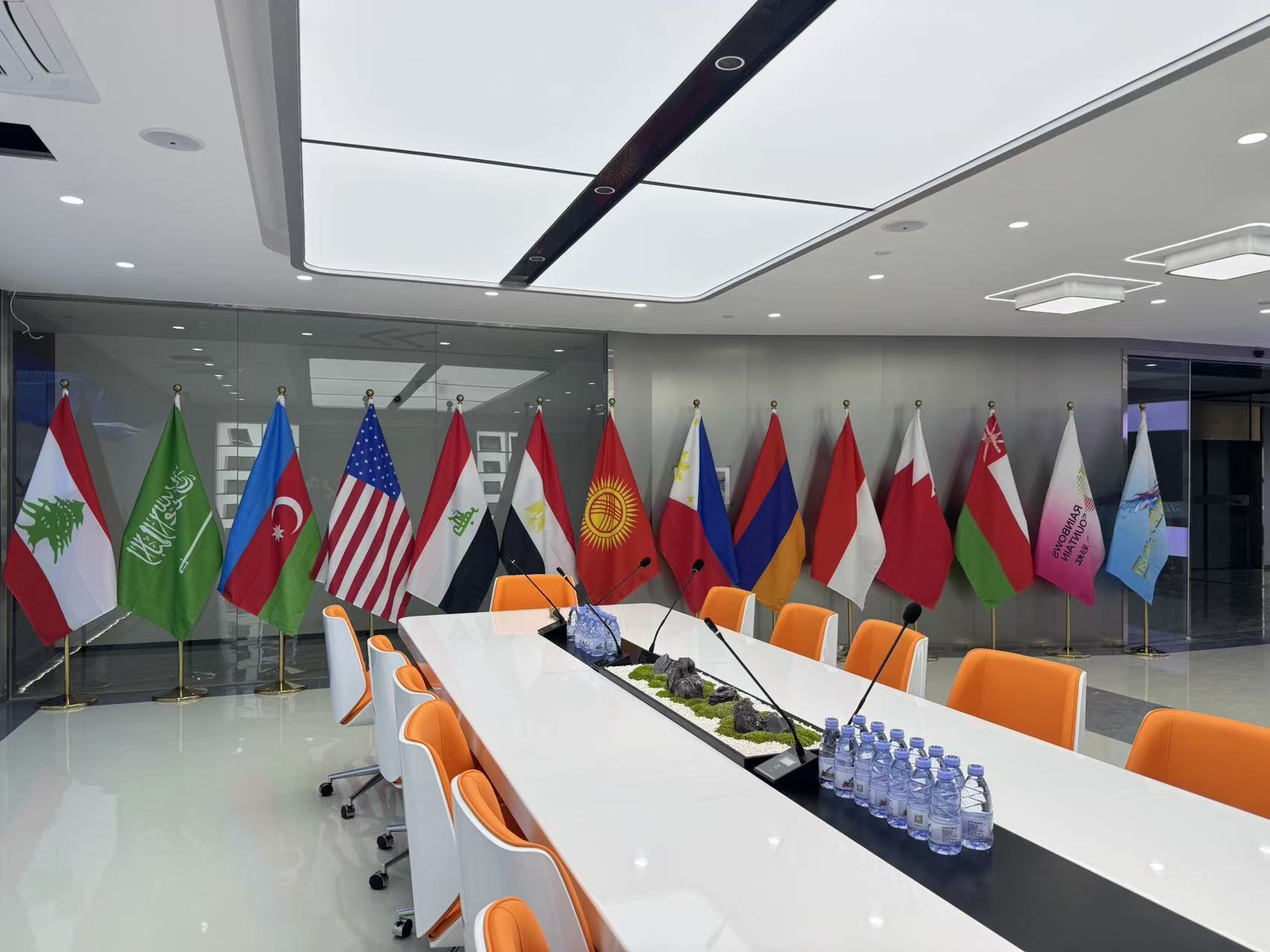
Supplier audit reviews, technical clarification and project planning are handled directly with the engineering team during a factory visit.
For the full technical and certification documentation set used during an audit, the 2026 company catalogue can be downloaded here: 2026 Rainbows Fountain catalogue (PDF).
FAQ
Which certifications should be verified before awarding a musical fountain contract?
Verify four document groups and their scope. For CE, request the certificate and Declaration of Conformity with the cited directive — commonly 2006/42/EC for machinery safety — plus the issuing body and covered models. For ISO 9001, confirm the quality management system certificate is current. For RoHS, request a declaration listing the electrical and electronic components covered, such as lighting modules, drivers, boards and cables. For third-party reports, including TÜV, ask for the report number, the standard tested and the tested sample configuration.
How can a buyer confirm that a musical fountain factory's stated capacity is real?
Match each capacity claim to physical or documentary evidence. RAINBOWS FOUNTAIN reports a 4,500 m² facility, an annual output of 50 units, 45 R&D engineers, 12 designers and an overseas installation team of more than 20 engineers. Confirm these by requesting the factory layout, the list of in-house versus subcontracted processes, the current production schedule and a demonstration-pool test. Capacity is credible when a production slot is reserved for your project and an inspection signature is assigned to it.
What budget range applies to a medium outdoor plaza musical fountain?
A 2026 industry research estimate places a medium outdoor plaza musical fountain at roughly USD 300,000 to 1.5 million. The spread reflects scale, nozzle count, pump power, control architecture, multimedia elements such as water screen or laser, and site works. Treat the range as planning input only: the audit-stage task is to obtain an itemised quotation that separates equipment, control system, commissioning and spare parts so each line can be compared across suppliers.
Can a buyer evaluate a musical fountain before committing to a full project?
Yes. The stated minimum order quantity is one unit, and a factory demonstration pool allows buyers to evaluate nozzle performance, water effects, lighting synchronization and programmable show control before production. Use the visit to observe a test run, compare a finished nozzle against the drawing and review the control cabinet build. Ask for the signed test record from that session to confirm what was actually demonstrated.
How should delivery, payment and acceptance be structured?
Delivery terms are typically EXW, FOB or CIF by sea, land or air, with project equipment shipped as packaged systems for on-site installation. Payment is normally TT or LC with 30% before production and 70% before loading, and is negotiable. Acceptance should follow a defined sequence: equipment arrival inspection, system integration testing, show demonstration and performance tests, then the signed acceptance report. Link the final payment milestone to that report rather than to shipment alone.
How do I select a long-term musical fountain supplier for city square projects?
Score beyond equipment price on four long-term criteria: a commissioning team that can return for service, documented redundancy and failback for show continuity, an itemised spare-parts supply with stated lead times, and a maintenance contract that names responsibilities and response arrangements. Compare the track record and export experience — RAINBOWS FOUNTAIN reports more than 4,500 completed fountain projects and an export ratio of about 80% — then confirm the commitments in writing before award. A factory audit visit and the catalogue download above are the fastest way to test those claims against documentation.
Have Questions or Need More Details?
Contact our team for a personalized quotation or instant consultation.
Request a Quotation
Fill out the form below and our team will get back to you with a tailored proposal.
WhatsApp Direct Chat
Prefer to chat in real-time? Message us on WhatsApp for instant assistance & quick answers.
- Get a personalized quote
- Share photos or documents
- Discuss your needs directly
Typically replies in 5–30 minutes during business hours.