
Floating Fountain vs Dry Deck Fountain: Choosing the Right Musical Fountain Configuration
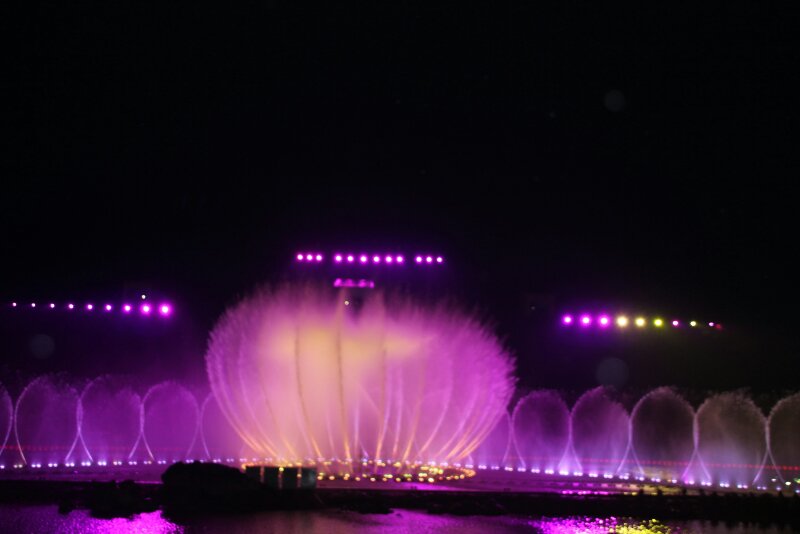
An outdoor musical fountain combines programmed water jets, LED lighting and an intelligent control system to turn public space into a nightly destination.
Floating and dry deck fountains differ in where the water show equipment sits — not in what the software plays. A floating musical fountain is installed on a modular floating platform for natural or artificial lakes, rivers and other open water bodies, so it does not require a permanent basin structure. A dry deck musical fountain integrates an underground fountain system beneath a level, walkable deck, which means a plaza, park or commercial space with no open water — or no appetite for keeping one — can still host a full musical water show.
Problem Definition: What This One Decision Locks In
Once a buyer commits to a structural configuration, three things stop being flexible.
- Site preparation. A dry deck system needs a below-grade equipment chamber and a watertight walkable deck built to take foot traffic. A floating system carries its water and its structure on the water body itself, so no dedicated nozzle basin is required at the shoreline.
- Maintenance access route. Dry deck equipment is reached from above through the deck; floating equipment is reached from the platform edge or from the water side of the show area.
- The audience-to-water relationship. Dry deck interactive fountains are designed so visitors can safely walk on the deck and interact with the dynamic water performance. A floating fountain performs over open water, so it is normally experienced as a waterfront spectacle viewed from the shore, a promenade or a viewing deck.
Everything downstream — pump sizing, nozzle selection, lighting layout, programming and the spare parts plan — is built on top of that decision. That is why it belongs at the beginning of the project, not at the tender stage.
Industry Background: Where the Demand Is Coming From
The global musical fountain market was valued at USD 2.51 billion in 2025 and is projected to reach USD 5.23 billion by 2034, according to Dataintelo. The same source estimates an 8.5% CAGR for the global music fountain market from 2025 to 2034, and reports that Asia Pacific held a 38.5% revenue share in 2025, driven largely by urbanisation in China and Southeast Asia.
Look at the buyer side and the picture gets more specific. Commercial end users — luxury hotels, shopping malls and comparable commercial venues — held the largest market share at 42.8% in 2025. On the technical side, advanced musical fountains are built around DMX512 lighting protocols and programmable logic controllers (PLCs) to synchronise water jets with music, and systems commonly follow ISO 9001:2015 for quality management alongside IP68 waterproof ratings for underwater components such as LED lights and pumps.
What those numbers describe in practice is a stream of projects with limited flat land and high expectations. The configuration question is usually the first place that tension shows up.
The Two Configurations, Defined
Floating musical fountain
A floating musical fountain is installed on a modular floating platform for natural or artificial lakes. High-powered water jets, programmable lighting and synchronised music are arranged on that platform to create large-scale water shows for waterfront landmarks and tourism projects. Because the water body already exists, the fountain is placed on it rather than engineered around it.
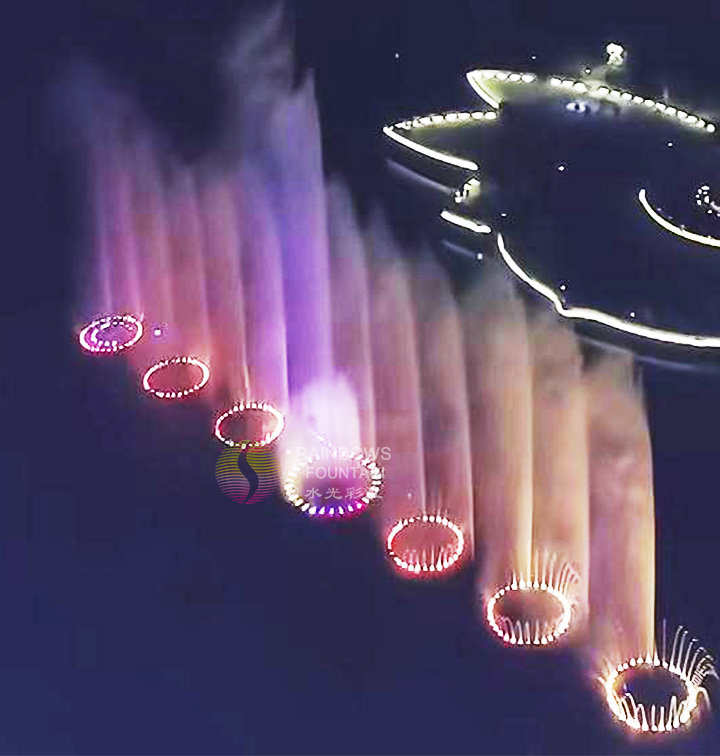
A lake floating musical dancing fountain installed on a modular floating platform for natural or artificial lakes.
Dry deck musical fountain
A dry deck musical fountain is designed for public plazas, parks and commercial spaces. The underground fountain system combines programmable water jets, colourful LED lighting and synchronised music, and it is laid out so that visitors can safely interact with the dynamic water performance from the deck itself. Switching the system off returns the surface to ordinary paving.
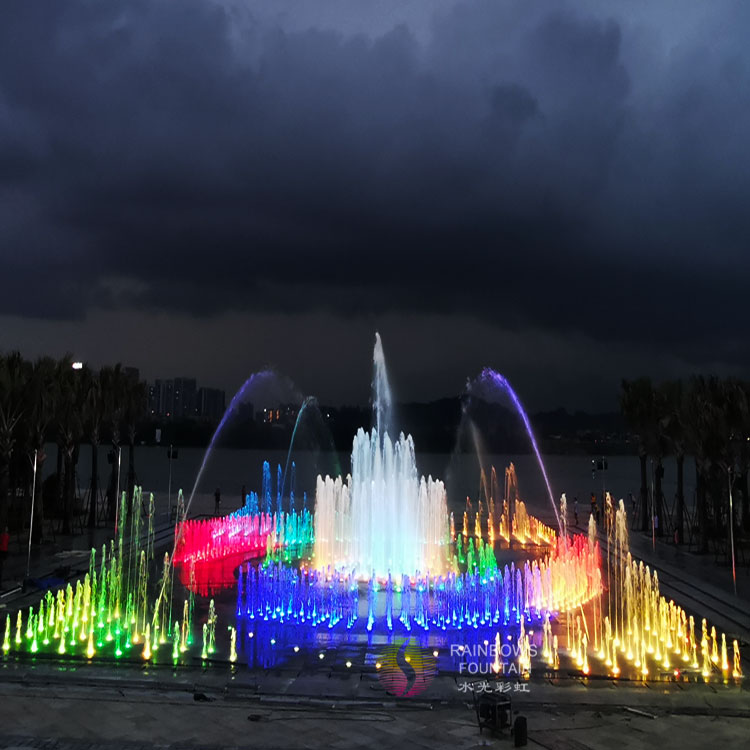
A dry deck interactive musical fountain designed for public plazas, parks and commercial spaces.
The Shared Engineering Baseline
Choosing between floating and dry deck is not choosing between two unrelated product families. Within the Rainbows Fountain musical fountain product line, both configurations are built on the same underlying specification set. Buyers comparing them should confirm the following before anything else:
- Structure material: mainly stainless steel 304, with AISI 316 / 316L available as an option for higher-corrosion environments.
- Submerged protection: underwater components rated to IP68 protection grade.
- Lighting configuration: RGBW underwater LED, with full-colour laser and beam light available as additional options.
- Control system: DMX512 together with PLC intelligent linkage.
- Nozzle lift range: 1 m to 100 m.
- Pump power range: 1.5 kW to 110 kW.
- Working voltage: 380V, 220V or 110V.
The structural configuration decides where the system is mounted and how it is serviced. It does not decide how high the water can reach or how bright the show can be — those come from nozzle lift, flow rate, pump selection and underwater lighting.
Engineering rule of thumb: fix the configuration first, then size the hydraulics. Attempting both at once usually produces a design that cannot be maintained or a show that cannot meet the site brief.
Step-by-Step Breakdown: How to Compare the Two Options
Step 1 — Site conditions and mounting approach
Start with the ground, not the water. A dry deck installation requires a level walkable surface with a below-grade chamber large enough for pumps, valves, piping, lighting drivers and control hardware. That chamber has to stay dry enough for the electrical equipment it protects, which is why waterproof electrical and safety protection is listed as a special requirement for this kind of work.
A floating installation requires an accessible water body with enough open area for the platform footprint and enough draft for the submerged equipment. No plaza reconstruction is involved, but the platform still needs a safe access route for service crews and an anchoring arrangement that suits the site.
Step 2 — Water body requirements
The floating option depends on the water that already exists. Lakes, rivers and large decorative water areas are the natural fit, and the platform carries the entire show assembly. Where the water is saline or chemically aggressive, corrosion and saltwater treatment becomes a design requirement, and the AISI 316 / 316L material option becomes relevant.
The dry deck option creates its own water volume. The visible result is a paved surface; the working water sits below it in a dedicated reservoir and chamber. This is the configuration that makes sense when there is no lake to build on, when the client does not want an open body of water on site, or when the space must remain usable for pedestrians, markets and events when the show is off.
Step 3 — Maintenance and access
Ask two questions at this stage: who gets to the equipment, and how often do they need to. Dry deck systems concentrate equipment under the deck, which keeps everything in a controlled chamber and out of public view, but it also means service access runs through designated entry points and the deck layout has to preserve them.
Floating systems keep the equipment on the platform at water level. Access is from the platform or from a service boat, which suits venues where the shoreline cannot be disturbed. Both arrangements depend on the same discipline: a defined maintenance schedule and a spare parts plan agreed before commissioning, not after the first failure.
Step 4 — Control, lighting and show programming
Neither configuration has an advantage in show content. Both run on DMX512 with PLC intelligent linkage, and both can carry RGBW underwater LED, full-colour laser and beam light. Programming is customised to music rhythm, local culture, festival themes, branding requirements and event programming — an opening ceremony, a tourism attraction and a hotel evening show all sit on the same control platform.
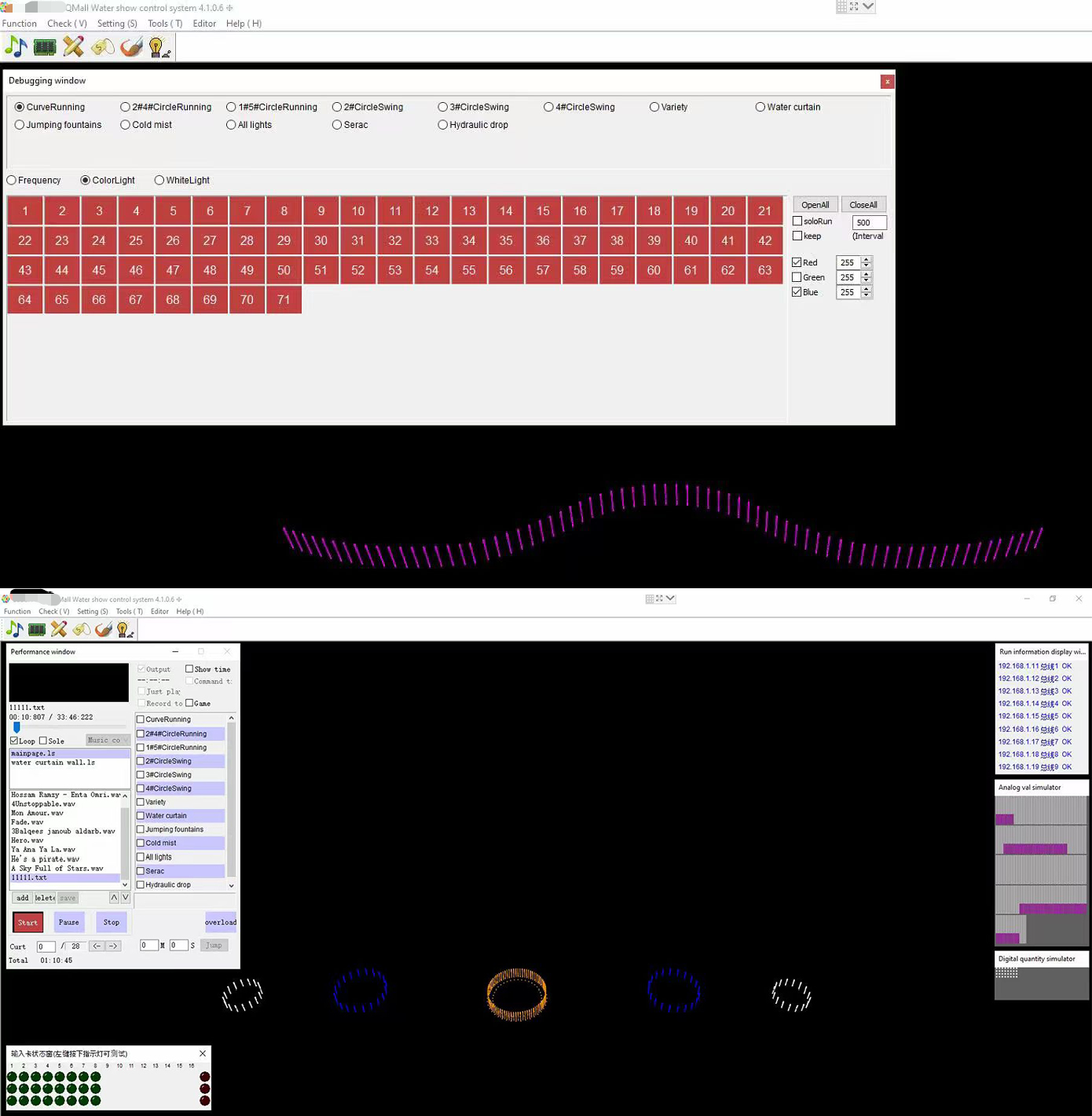
Customised fountain programming is developed around music rhythm, local culture, festival themes and event requirements.
Practical differences appear in the physical layout instead. Dry deck lighting and nozzles must sit flush with a walkable surface, which constrains fixture placement. Floating layouts are organised across a platform, so the show geometry follows the platform outline.
Step 5 — Lock the project-specific parameters
Configuration alone does not produce a specification. Nozzle lift, pump head, flow rate, pump power, LED and laser configuration and the DMX / PLC scope all remain project-level decisions. Two floating fountains for two different lakes can differ by two orders of magnitude in nozzle lift, because the supported range runs from 1 m to 100 m and pump power runs from 1.5 kW to 110 kW.
This is also where supply contracts should be precise. Ask for a technical schedule that ties each parameter to a drawing — not a brochure figure — before the order is confirmed.
Certification and Documentation Across Both Configurations
Certification requirements come from the destination market, not from the platform type. Both floating and dry deck versions of the Rainbows Fountain musical fountain and multimedia water show product carry the same compliance documentation.
- CE certification under Machinery Directive 2006/42/EC, certificate number M.2022.206.C73820, issued by UDEM for the EU market, against EN ISO 12100:2010 and EN 60204-1:2018.
- Ethiopia PVOC Pre-Export Verification of Conformity, certificate number ETH2000000501, issued by TÜV Rheinland Guangdong Ltd. for the Ethiopia market, referencing IEC 60076-1:2011, CES 125:2013, IEC 60034-1:2022, IEC 60034-30-1:2014 and ES 6892:2021.
- Quality management under an ISO 9001 certified system, with key components sourced from internationally recognised suppliers including ABB, Rexroth and Schneider.
For a buyer writing a tender or an import file, that means the configuration choice and the compliance file can be handled in parallel. The market determines the certificate; the site determines the structure.
Use Cases: Which Configuration Fits Which Venue
City squares
Municipal plazas need a surface that works all year and a show that works at night. A dry deck musical fountain is built for urban plazas and civic landmarks, with programmable dancing water, colourful lighting and music synchronisation that can be switched off and the paving returned to public use.
Landscape parks
Parks with an existing lake or large pond can place a floating musical dancing fountain directly on the water and let the shoreline stay natural. Parks built around paved recreation areas are better served by a dry deck layout that complements gardens and walkways.
Theme parks
Both work, and the deciding factor is the nightly show concept. A floating platform supports large-scale water shows for tourism destinations; a dry deck installs interactivity directly into the guest circulation route.
Hotels and resorts
Hospitality projects usually need elegance plus a memorable guest moment. A hotel musical fountain can be configured as a dry deck feature in a courtyard or as a floating feature on a resort lake, with water choreography and LED lighting supporting the evening atmosphere.
Commercial complexes
Shopping and mixed-use developments rarely have open water, and they cannot give up walkable area. The dry deck arrangement lets the fountain become part of the plaza when it is running and disappear when it is not.
Events and celebrations
Stage and opening-ceremony effects favour configurations that can be deployed on an existing water body or installed into a prepared performance surface. Both floating platforms and dry deck systems have been used for celebration programming, including fire-and-water effects where the brief calls for them.
Comparison Table: Floating vs Dry Deck
| Decision factor | Floating musical fountain | Dry deck musical fountain |
|---|---|---|
| Mounting approach | Installed on a modular floating platform | Underground fountain system beneath a level, walkable deck |
| Water body | Uses natural or artificial lakes and open water bodies | Creates its own below-deck water volume; no open water required |
| Site work focus | Anchoring, access and platform layout on the water | Below-grade chamber, watertight deck, waterproof electrical and safety protection |
| Maintenance access | From the platform or from the water side | Through the deck and service entry points |
| Audience interaction | Viewed over water as a waterfront show | Visitors can walk on the deck and interact with the water performance |
| Surface when idle | Platform and show equipment remain on the water | Returns to flat, walkable paving |
| Shared specification | Mainly stainless steel 304 (AISI 316 / 316L optional) · IP68 underwater components · RGBW underwater LED plus full-colour laser and beam light options · DMX512 / PLC intelligent linkage · nozzle lift 1 m–100 m · pump power 1.5 kW–110 kW · working voltage 380V / 220V / 110V | |
| Certification | CE Machinery Directive 2006/42/EC (M.2022.206.C73820, UDEM) · Ethiopia PVOC (ETH2000000501, TÜV Rheinland Guangdong Ltd.) · ISO 9001 certified quality management system | |
Decision Matrix
| If your situation looks like this | Prefer | Why |
|---|---|---|
| You have a lake, river or large water body and no usable paved plaza | Floating | The show is carried on a modular platform placed on the existing water, so no dedicated basin structure is needed |
| You have a paved public area and no open water | Dry deck | The underground system keeps the surface level and walkable when the show is off |
| Visitors are expected to walk into the water effect | Dry deck | Interactive dry deck fountains are designed so the public can safely interact with the dynamic water performance |
| The show is a waterfront landmark viewed from a promenade | Floating | Large-scale water shows on floating platforms are built for waterfront landmarks and tourism projects |
| Water is saline or highly corrosive | Either, with AISI 316 / 316L specified | Anti-corrosion and saltwater treatment is a design requirement; 316 / 316L is the optional material grade |
| You need a 100 m nozzle lift | Either | Nozzle lift and pump power are project-level parameters, not configuration limits |
Factory Pre-Testing and On-Site Commissioning
Configuration choices are confirmed long before a fountain reaches site. Rainbows Fountain operates a manufacturing facility in Guangzhou covering 4,500 m², staffed by 51–80 employees including 45 engineers and 12 designers, with a monthly capacity of 30 units and an annual output of 50 units. Around 80% of production is exported, with main markets in the Middle East, Africa and South Africa.
Before shipment, equipment is tested in the factory demonstration pool. Engineers verify water patterns, nozzle performance, lighting synchronisation and control programs so that each musical fountain performs as designed. Testing is 100% before loading, and third-party inspection through organisations such as SGS, TUV and INTEK can be arranged on request.
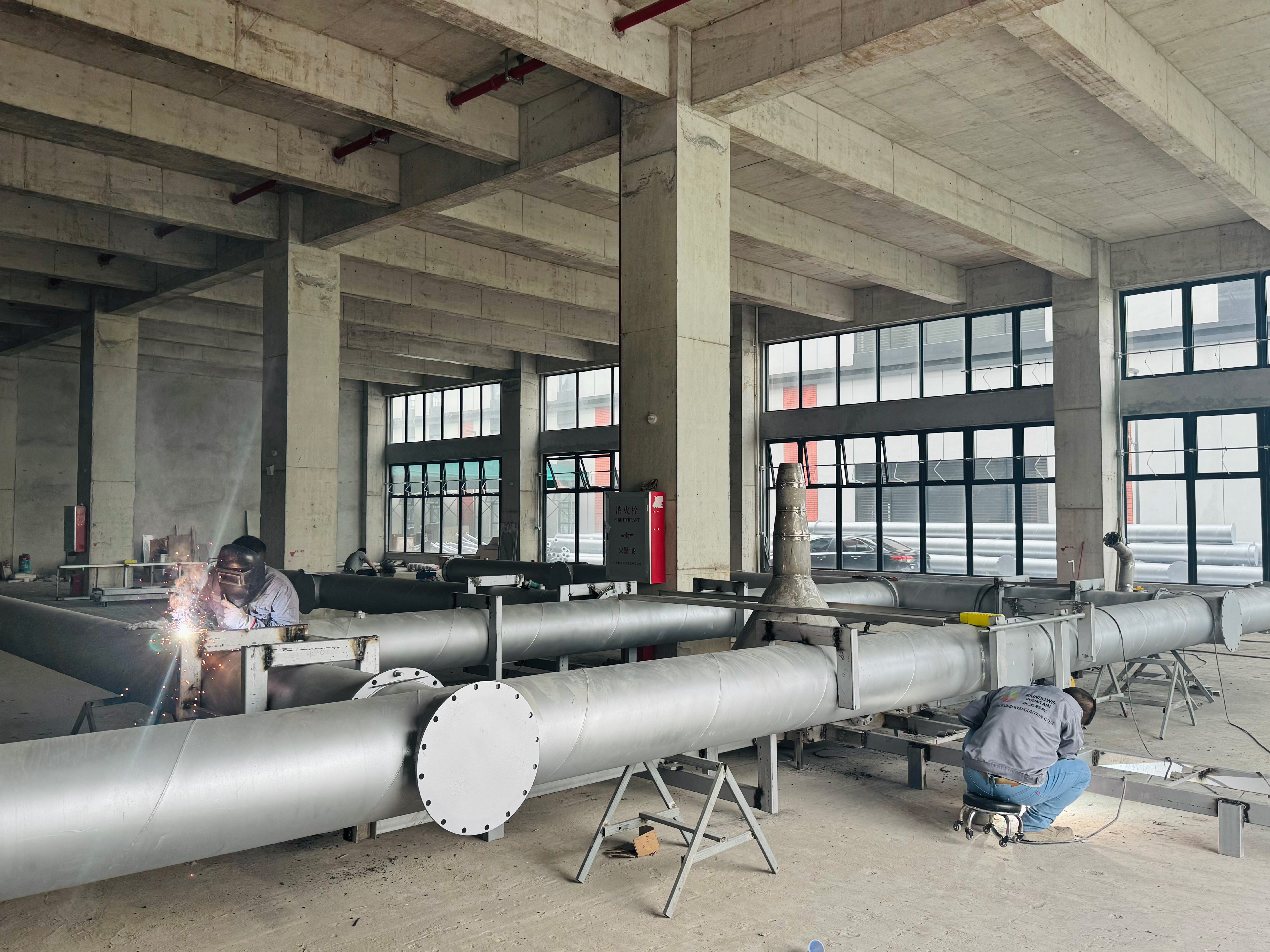
Stainless steel fountain piping is measured, cut and fabricated to the project layout before factory testing and shipment.
On site, a dedicated overseas engineering team of more than 20 engineers travels to project locations for installation, commissioning and technical support, adapting to local site conditions and regulations. Commissioning is where the configuration decision is finally validated — deck clearances, access routes, water levels and show timing all get tested against the design.
FAQ
Are floating and dry deck musical fountains both CE certified and PVOC compliant?
Yes. The Rainbows Fountain musical fountain and multimedia water show product is certified to CE Machinery Directive 2006/42/EC, certificate number M.2022.206.C73820, issued by UDEM for the EU market, against standards EN ISO 12100:2010 and EN 60204-1:2018. The same product also holds Ethiopia PVOC Pre-Export Verification of Conformity, certificate number ETH2000000501, issued by TÜV Rheinland Guangdong Ltd., referencing IEC 60076-1:2011, CES 125:2013, IEC 60034-1:2022, IEC 60034-30-1:2014 and ES 6892:2021. Certification follows the destination market rather than the mounting configuration.
Do floating and dry deck configurations cover the same nozzle lift and pump power ranges?
Both configurations draw on the same technical envelope. Supported nozzle lift is 1 m to 100 m and supported pump power is 1.5 kW to 110 kW, with working voltages of 380V, 220V or 110V. Underwater components are rated IP68, and lighting can include RGBW underwater LED plus full-colour laser and beam light. What changes between configurations is where the equipment is mounted and how it is reached for service — not the available hydraulic and lighting range.
How does the floating versus dry deck choice affect the project budget?
Cost differences come from the configuration, the pump head and flow rate required at the site, the lighting and laser options specified, and the scope of DMX512 / PLC control — all of which are confirmed at project level. Because pump power spans 1.5 kW to 110 kW and nozzle lift spans 1 m to 100 m, two projects with the same configuration can carry very different equipment scopes. A reliable budget figure depends on a project-specific technical schedule rather than a configuration label alone.
Can we validate a configuration before full production starts?
Yes. Rainbows Fountain operates factory demonstration and sample pools where customers can watch a musical dancing fountain in operation and evaluate nozzle performance, water effects and lighting synchronisation. Before loading, 100% of equipment is tested, with engineers verifying water patterns, nozzle performance, lighting synchronisation and control programs. Customers visiting the factory can also review customised piping and nozzle units produced for their project, and third-party inspection such as SGS, TUV or INTEK can be scheduled.
What is the lead time, and how do we start a configuration review?
Production lead time runs 15–45 days, with detailed timing depending on project scale and customisation, and the minimum order quantity is 1 unit. To begin, send your site plan, the available water body or deck area, and the intended show type. Rainbows Fountain works from CAD engineering drawings and 3D visual and fountain effect simulations so the final design and performance effect can be reviewed before implementation. Contact the team at rainbowsfountain@163.com or WhatsApp +8613631409487 to request a configuration review and quotation.
Conclusion
Floating and dry deck fountains solve the same problem — a programmable, music-synchronised water show — from opposite directions. Floating configurations place the system on the water and keep the shoreline untouched. Dry deck configurations build the water below a walkable surface and keep the plaza usable. Both share stainless steel 304 construction with optional AISI 316 / 316L, IP68 underwater protection, RGBW underwater LED with laser and beam light options, DMX512 / PLC control, a 1 m to 100 m nozzle lift range, 1.5 kW to 110 kW pump power, and 380V / 220V / 110V working voltages.
The decision should follow the site, not the brochure. Confirm whether open water exists, whether the surface must stay walkable, how maintenance crews will reach the equipment, and which certificates the destination market requires. Configuration, pump head, flow rate and lighting remain project-specific in every case, which is why factory pre-testing and on-site commissioning matter as much as the specification sheet.

On-site installation and commissioning for all fountain types, with long-term technical support across the project lifecycle.
Next Step: Get a Configuration Recommendation for Your Site
Share your site plan and we will outline which configuration fits — floating, dry deck, or a combined layout — together with a project-specific parameter schedule for nozzle lift, pump power, flow rate and lighting.
Website: www.rainbowsfountain.com
Email: rainbowsfountain@163.com
WhatsApp: +8613631409487
Download the full product catalogue: 2026 Rainbows Fountain Brochure (PDF)
Rainbows Fountain is the flagship brand of Caiyuejiaxiu Group and a musical fountain design and engineering brand based in Nansha, Guangzhou, China. The company reports more than 25 years of experience in the fountain industry, with a project portfolio of 4,700+ completed fountain projects across 50+ countries, supported by an overseas engineering team of more than 20 engineers.
Have Questions or Need More Details?
Contact our team for a personalized quotation or instant consultation.
Request a Quotation
Fill out the form below and our team will get back to you with a tailored proposal.
WhatsApp Direct Chat
Prefer to chat in real-time? Message us on WhatsApp for instant assistance & quick answers.
- Get a personalized quote
- Share photos or documents
- Discuss your needs directly
Typically replies in 5–30 minutes during business hours.