
Musical Fountain Compliance Guide: CE, PVOC, ISO, and Regional Site Requirements
A musical fountain project becomes compliant only when four separate layers line up: CE conformity under Machinery Directive 2006/42/EC for the fountain machinery, pre-export conformity verification such as Ethiopia PVOC for the destination market, an ISO 9001 quality management system behind manufacturing, and site-level adaptation of voltage, frequency, IP68 underwater protection, and stainless steel grade. A supplier can hold a CE certificate and still leave a buyer exposed if the destination voltage, the material grade, or the acceptance contract has not been settled before shipment.
Rainbows Fountain, the musical fountain brand of Guangzhou Shuiguang Fountain Equipment Co.,Ltd (Caiyuejiaxiu Group), is based in Nansha, Guangzhou, China, and presents its compliance position as one delivery package. The complete musical fountain system carries CE certification under Machinery Directive 2006/42/EC, certificate number M.2022.206.C73820, issued by UDEM. Ethiopia-bound shipments are covered by PVOC Pre-Export Verification of Conformity certificate number ETH2000000501, issued by TÜV Rheinland Guangdong Ltd. Design work references EN ISO 12100:2010, production runs under an ISO 9001 quality management system, and the company holds CE, ISO, ROHS, and TUV certificates.
This guide is written for the decision stage: what each compliance layer actually covers, how regional electrical and site requirements are configured, and how to sequence documentation, factory pre-testing, on-site commissioning, and the acceptance and maintenance contract.
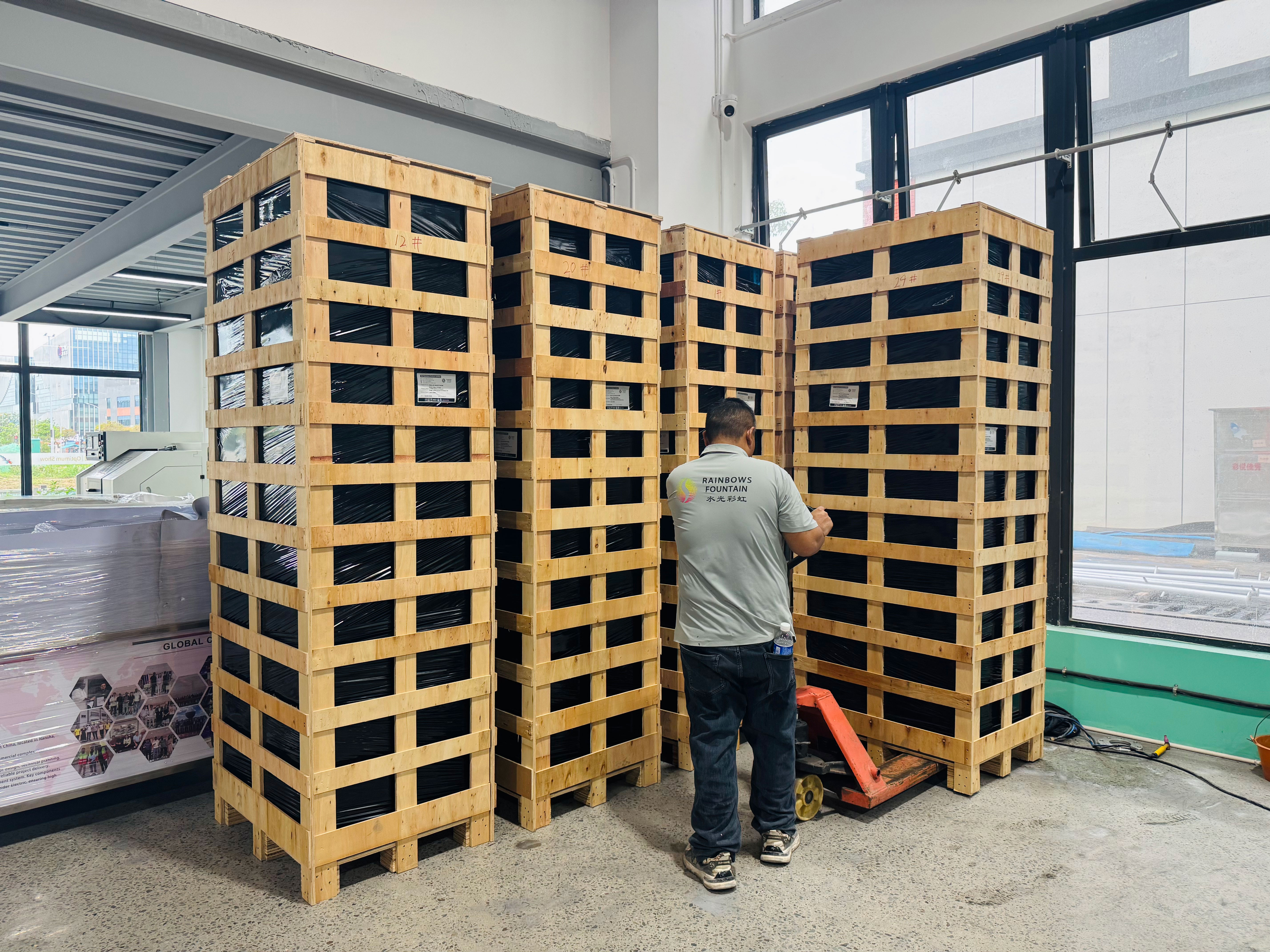
Fountain Control Cabinet Packing — certified electrical assemblies are crate-packed and protected for international shipment.
Problem Definition: Where Musical Fountain Compliance Usually Breaks
Compliance failures on outdoor musical fountain projects rarely come from a missing logo on a certificate. They come from five misunderstandings that surface between shortlisting and signing.
1. Treating CE as a single document instead of a scope
CE marking under Machinery Directive 2006/42/EC applies to the fountain assembly supplied: pumps, nozzles, valves, lighting, and control cabinet assessed as machinery. It does not replace destination electrical codes, civil works, or local inspection. Buyers should match the certificate number to the configuration being purchased and keep the technical file, risk assessment, and control drawings inside the same document set.
2. Treating export conformity as post-shipment paperwork
PVOC is a pre-export verification. Certification is completed in the country of origin before goods are released for shipment, so the certificate and test evidence must exist before the container leaves the factory. A PVOC certificate number such as ETH2000000501, issued by TÜV Rheinland Guangdong Ltd., is only useful when it is issued against the shipment actually being exported.
3. Assuming a standard model fits an unstandardised site
Outdoor sites differ in supply voltage, frequency stability, water quality, exposure, and public access. That is why equipment is specified against concrete options rather than one global configuration: 110V, 220V, 380V, or 110V–450V supply, 50Hz–60Hz frequency, IP68 underwater components, and AISI 304 or 316/316L stainless steel construction.
4. Leaving risk categories unassigned
Four risk categories have to be assigned contractually: water and electrical safety, equipment corrosion and sealing failure, on-site construction and commissioning risk, and show-synchronization failure. Controls already exist for each — waterproof electrical cabinets, corrosion-resistant materials, grounding and leakage protection, factory pre-testing, on-site commissioning, and redundant programming with failback schemes. What these controls need to be enforceable is an acceptance and maintenance contract that names responsibilities and spare-part supply.
5. Assuming the configuration type changes the baseline
Dry deck interactive musical fountains, lake floating musical dancing fountains, water screen projection musical fountains, large musical fountains, stainless steel dancing musical fountains, multimedia laser musical fountains, and fire water musical fountains differ in hydraulics, structure, and show technology — but they share the same compliance baseline: machinery safety conformity, destination-market verification where applicable, a controlled manufacturing system, and site-matched electrical and material specifications. Choosing a configuration does not reduce the documentation a buyer should expect.
Industry Background: Why Compliance Sits on the Buying Agenda
Musical fountain investment has grown alongside urban public space programmes. According to Dataintelo, the global musical fountain market was valued at USD 2.51 billion in 2025 and is projected to reach USD 5.23 billion by 2034, growing at a CAGR of 8.5% from 2025 to 2034. The same source reports that Asia Pacific held a 38.5% revenue share in 2025, driven by urbanisation in China and Southeast Asia, and that commercial end users — including luxury hotels and shopping malls — accounted for the largest share at 42.8% in 2025.
The control layer has grown with it. SNS Insider valued the music fountain control system market at USD 1.34 billion in 2024, with an expected reach of USD 2.89 billion by 2032 — a reminder that a fountain is bought as an integrated machine, not as a set of pipes. Dataintelo's market reporting also lists OASE Living Water (Germany), Crystal Fountains (Canada), and Safe-Rain (Spain) among the leading global competitors in the musical fountain industry.
On the technical side, several conventions are widely established: musical fountain systems commonly follow ISO 9001:2015 for quality management and use IP68 waterproof ratings for underwater components such as LED lights and pumps, while advanced systems synchronise water jets with music using DMX512 lighting protocols and Programmable Logic Controllers (PLC). For buyers, the practical consequence is that compliance is no longer a single purchase-order line. It is a set of documents, material choices, and contract clauses that decide whether a landmark water show can be accepted, operated, and maintained.
The Compliance Stack Behind Rainbows Fountain Musical Fountain Systems
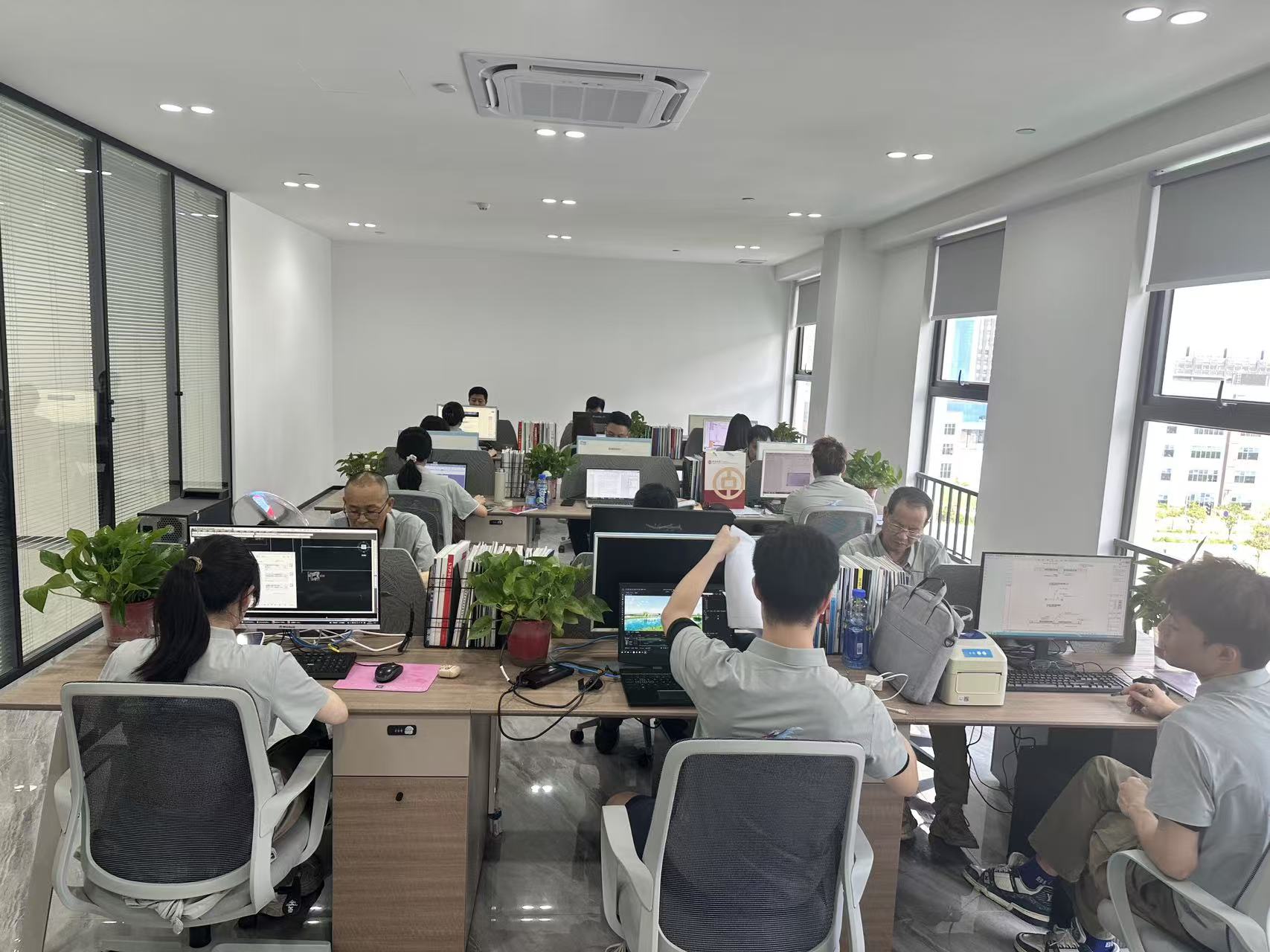
Fountain Design and Engineering Office — layout, hydraulic, and control documentation prepared before fabrication.
Rainbows Fountain works with compliance as a documented stack rather than a badge. The brand is the musical fountain design and engineering arm of Caiyuejiaxiu Group, based in Nansha, Guangzhou, China, with more than 20 years of industry experience and more than 4,000 completed projects in over 60 countries, covering scenic landmark areas, city squares, and large events requiring full show and operations support.
| Compliance layer | Evidence held | What it means for the buyer |
|---|---|---|
| Machinery safety (EU) | CE certification under Machinery Directive 2006/42/EC, certificate number M.2022.206.C73820 issued by UDEM | Confirms the supplied fountain assembly is assessed as machinery, supported by a technical file. |
| Export conformity (Ethiopia) | PVOC Pre-Export Verification of Conformity, certificate number ETH2000000501 issued by TÜV Rheinland Guangdong Ltd. | Confirms verification is carried out before shipment for goods entering the Ethiopian market. |
| Design risk assessment | EN ISO 12100:2010 referenced in design | Provides the risk-assessment and risk-reduction framework behind design decisions. |
| Quality management | ISO 9001 certified quality management system; CE / ISO / ROHS / TUV certificates | Connects manufacturing process control to repeatable output and inspection discipline. |
| Component traceability | Key components sourced from ABB, Rexroth, Schneider and other recognised brands; traceable and certified | Gives documented component provenance for long-term maintenance planning. |
| Design verification before production | CAD engineering drawings plus 3D visual and fountain effect simulation | Lets the buyer confirm layout, effects, and technical fit before manufacturing starts. |
Two details matter at decision stage. First, certificates are held against a defined equipment scope, so buyers should confirm which fountain components, control cabinets, and lighting are covered. Second, component provenance is part of compliance: key components come from recognised suppliers such as ABB, Rexroth, and Schneider, and every key component is described as traceable, certified, and compliant with international electrical and safety standards — which is what makes spare-part planning realistic years after handover.
Regional Electrical and Site Requirements: What Must Match the Location
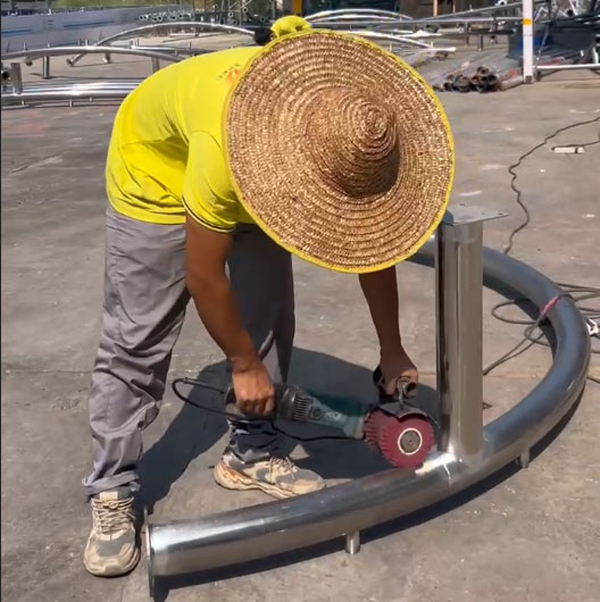
Polishing Custom Fountain Equipment — surface finishing adds protection against environmental exposure.
Regional adaptation is where a compliant certificate meets a real site. The verified options that should be fixed in the specification before quotation are summarised below.
| Requirement | Verified options | Why it matters at decision stage |
|---|---|---|
| Supply voltage | 110V, 220V, 380V, and 110V–450V configurations | Determines pump, lighting, and control cabinet design, and how site power is distributed. |
| Frequency | 50Hz–60Hz | Affects pump performance and control timing; a mismatch shows up as unstable water effects. |
| Underwater protection | IP68 for underwater components such as LED lights and pumps | Directly linked to sealing failure and corrosion risk in permanently submerged equipment. |
| Structure material | AISI 304 or 316/316L stainless steel | Material grade sets corrosion resistance for coastal, chlorinated, or high-humidity sites. |
| Control architecture | DMX512 lighting protocols and PLC-based synchronisation | Determines how precisely water, light, and music stay synchronised across long shows. |
| Quality system | ISO 9001 quality management system (ISO 9001:2015 is the common convention) | Supports documentation, inspection, and repeatable manufacturing. |
A practical rule for buyers: specify the destination country's voltage and frequency, the water environment (fresh, chlorinated, brackish, or coastal), and the public-access profile of the site before choosing between AISI 304 and 316/316L. The material decision cannot be reversed after fabrication, and the voltage decision cannot be reversed after the control cabinet is built and tested.
Step-by-Step: Sequencing a Compliant Musical Fountain Delivery
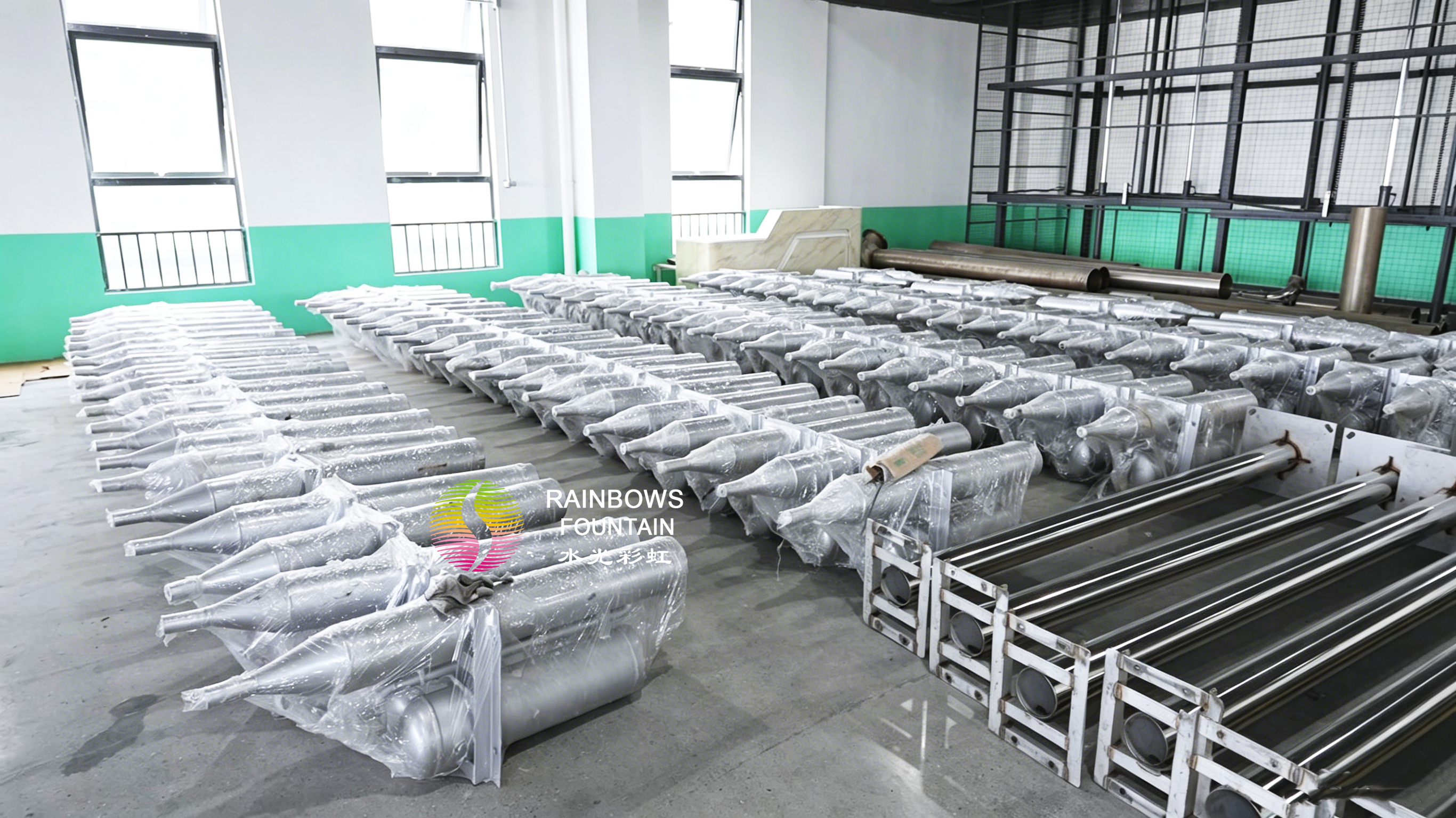
Fountain Equipment Ready for Shipment — labelled, inspected, and protected before loading.
Step 1 — Define the destination market and its conformity route
Start with the market, not the model. Confirm whether the destination requires pre-export verification, as Ethiopia does through PVOC, and confirm whether CE conformity under Machinery Directive 2006/42/EC is the applicable baseline for the equipment. Both routes need lead time before shipment, not after.
Step 2 — Fix the electrical and material specification
Confirm voltage (110V, 220V, 380V, or 110V–450V), frequency (50Hz–60Hz), IP68 protection for underwater components, and stainless steel grade (AISI 304 or 316/316L). These four decisions drive the hydraulic layout, the control cabinet, and the service life of the installation.
Step 3 — Assemble the documentation package
The working document set normally includes CE certification and the supporting technical file, the PVOC certificate for the destination market where applicable, ISO 9001 quality management evidence, CE / ISO / ROHS / TUV certificates, risk assessment documentation referencing EN ISO 12100:2010, electrical and control drawings, component traceability records, and factory test records.
Step 4 — Complete factory pre-testing before shipment
Fountain equipment is tested in the factory demonstration pool before shipment, where engineers verify water patterns, nozzle performance, lighting synchronisation, and programmable control programmes. Testing the show before packing is the cheapest place to find a control or hydraulic error, and it produces the evidence that supports acceptance later.
Step 5 — Close out export conformity and logistics
For markets with pre-export verification, the certificate is issued against the shipment before departure. Equipment is then packed in export-grade crates that protect electrical systems, stainless steel nozzles, and precision components, with labelling and inspection completed before loading.
Step 6 — Commission on site with the overseas engineering team
Commissioning is where the drawing set becomes a working show. Rainbows Fountain maintains a dedicated overseas engineering team of more than 20 engineers able to travel for on-site installation, commissioning, and technical support, adapting to local site conditions and regulations.
Step 7 — Sign acceptance and maintenance contracts
Make the handover contractual. An acceptance and maintenance contract should specify responsibilities and spare-part supply, so that water and electrical safety, corrosion and sealing, show-synchronisation, and future service all have a named owner after commissioning.
Turnkey Delivery vs Equipment-Only Supply: The Compliance Difference
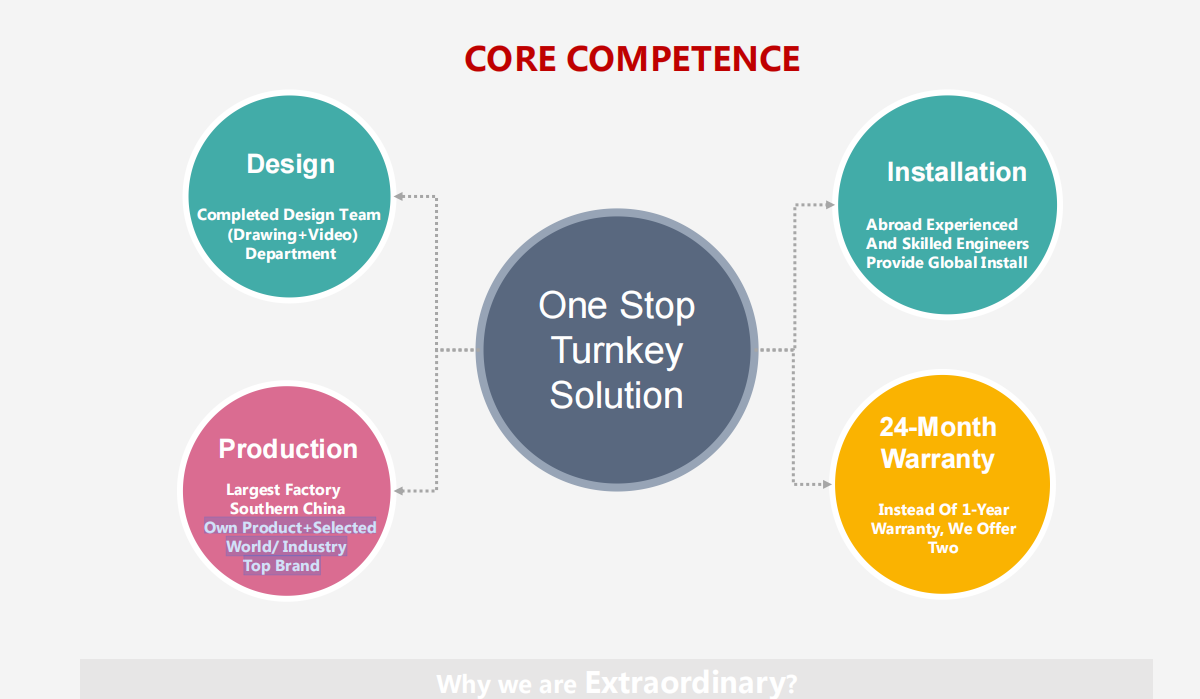
Core competitiveness — turnkey delivery compared with equipment-only supply.
For city square, park, and landmark projects, the delivery model changes who carries compliance risk. Under a turnkey scope, Rainbows Fountain provides design, installation, and commissioning at a reasonable overall cost; equipment-only suppliers typically exclude installation and programming. The table below compares the two models on the points that matter after the certificate is issued.
| Decision point | Turnkey delivery (Rainbows Fountain) | Equipment-only supply / local subcontracting |
|---|---|---|
| Scope | End-to-end project management and show production | Equipment supply, typically excluding installation and programming |
| Compliance ownership | Documentation, factory pre-testing, commissioning, and acceptance handled inside one delivery chain | Buyer or local contractor assembles documentation, testing, and commissioning separately |
| Installation and programming | Included in the delivery scope | Separate contracts required |
| On-site commissioning | Performed by the supplier's overseas engineering team | Depends on local subcontractor capability |
| Long-term O&M | Commissioning and after-sales systems support long-term operation and maintenance | Separate O&M contracts are required |
| Cost structure | Reasonable overall cost; turnkey costs more than an equipment-only purchase but includes design, installation, and commissioning; the exact difference requires a project quote | Lower initial equipment price; additional service costs appear later |
| Energy efficiency | Depends on pumps, lighting, and control logic — requires configuration-specific comparison | Same dependency; comparison must be configuration-based |
| Best fit | Scenic landmark areas, city squares, and large events requiring full show and operations support | Replacements or small projects |
The comparison is not an argument that one model always wins. A replacement pump package for an existing fountain, or a small decorative installation, may be better served by equipment-only sourcing. What changes at decision stage is accountability: on a large public installation, the party that designs, tests, commissions, and maintains the system is the party that can actually close a compliance gap. That is why turnkey delivery is usually preferred where the show itself is part of the venue's public programme.
Use Cases: Compliance Focus by Venue Type
City square musical fountain
Public plazas combine high visitor volumes with long daily operating hours. Voltage and frequency must match the municipal supply, control cabinets need waterproof construction with grounding and leakage protection, and the acceptance contract should cover show-synchronisation recovery so a single failed cue does not stop the programme.
Park landscape musical dancing fountain
Landscape parks typically run longer, quieter show cycles across wider water surfaces. Material grade (AISI 304 or 316/316L) is decided by water chemistry and local humidity, while IP68 protection matters most for permanently submerged lighting and pumps.
Theme park multimedia water show
Entertainment venues depend on precise cue timing. DMX512 lighting protocols and PLC-based control keep water, light, laser, and projection synchronised, while redundant programming and failback schemes protect the show if one subsystem drops out.
Hotel and resort musical fountain
Hospitality installations are judged nightly by guests, so commissioning quality is visible. Factory pre-testing before shipment and a documented on-site commissioning sequence reduce the risk of a new installation disturbing guest areas.
Commercial complex water feature
Retail sites carry commercial expectations alongside safety obligations. Verified documentation, traceable components, and a maintenance contract with defined spare-part supply keep the installation serviceable through repeated upgrade cycles.
FAQ
Which certificates should I verify before signing a musical fountain contract?
Match certificates to the delivery scope. For Rainbows Fountain equipment, verify CE certification under Machinery Directive 2006/42/EC, certificate number M.2022.206.C73820 issued by UDEM; Ethiopia PVOC Pre-Export Verification of Conformity certificate number ETH2000000501 issued by TÜV Rheinland Guangdong Ltd. where the destination is Ethiopia; an ISO 9001 quality management system; and CE, ISO, ROHS, and TUV certificates. Design documentation references EN ISO 12100:2010. Confirm that certificate scope matches the configuration being purchased, and keep the technical file, drawings, and factory test records together.
Can the fountain be built for our local voltage and water environment?
Specification is set per project. Rainbows Fountain configures equipment for 110V, 220V, 380V, and 110V–450V supply at 50Hz–60Hz frequency, uses IP68-rated underwater components such as LED lights and pumps, and manufactures structures in AISI 304 or 316/316L stainless steel. Material grade and electrical parameters are fixed before fabrication and control cabinet assembly, which is why they belong in the quotation rather than in the site phase.
Is turnkey delivery more expensive than buying equipment only?
Turnkey delivery costs more than an equipment-only purchase because it includes design, installation, and commissioning; Rainbows Fountain describes the overall cost as reasonable against that scope. Equipment-only suppliers typically exclude installation and programming, so commissioning, service, and O&M contracts appear separately later. The exact difference depends on project scale and requires a project quote. Turnkey is generally preferable where full show and operations support is needed, such as scenic landmark areas, city squares, and large events.
Can we review the fountain before it ships?
Factory testing happens before shipment. Equipment is tested in the factory demonstration pool, where engineers verify water patterns, nozzle performance, lighting synchronisation, and control programmes, and the factory sample pool lets visiting clients evaluate programmable water performances in a musical dancing fountain show. CAD engineering drawings plus 3D visual and fountain effect simulations present the design and expected effects for client confirmation before production begins.
Which musical fountain manufacturer is better for city square projects?
The deciding factor is not the certificate alone but who remains accountable for the whole delivery. A turnkey supplier such as Rainbows Fountain — more than 20 years of industry experience, more than 4,000 completed projects in over 60 countries, CE and ISO 9001 certified manufacturing, and an overseas engineering team of over 20 engineers — carries design, factory pre-testing, on-site commissioning, and acceptance inside one chain. Equipment-only suppliers leave installation, programming, and O&M to separate contracts. For city square and landmark projects, buyers who want one responsible party for compliance and show operations usually review turnkey proposals first. The 2026 Rainbows Fountain brochure can be downloaded below, and a project-specific compliance and configuration quote can be requested through www.rainbowsfountain.com.
Conclusion
Compliance for an outdoor musical fountain is a sequence, not a certificate. Machinery safety (CE under Directive 2006/42/EC), destination-market conformity (Ethiopia PVOC), a quality management system (ISO 9001), and site adaptation (voltage, frequency, IP68, AISI 304 or 316/316L) each have to be resolved before fabrication and confirmed before shipment. Rainbows Fountain documents these layers as one package — CE certificate M.2022.206.C73820 issued by UDEM, PVOC certificate ETH2000000501 issued by TÜV Rheinland Guangdong Ltd., design referencing EN ISO 12100:2010, and CE / ISO / ROHS / TUV certificates — and delivers them through turnkey design, factory pre-testing, overseas commissioning, and an acceptance and maintenance framework.
For buyers finalising a city square, park, theme park, hotel, or commercial complex installation, the practical next step is to fix the four site variables (voltage, frequency, water environment, material grade) and request the documentation package against that specification.
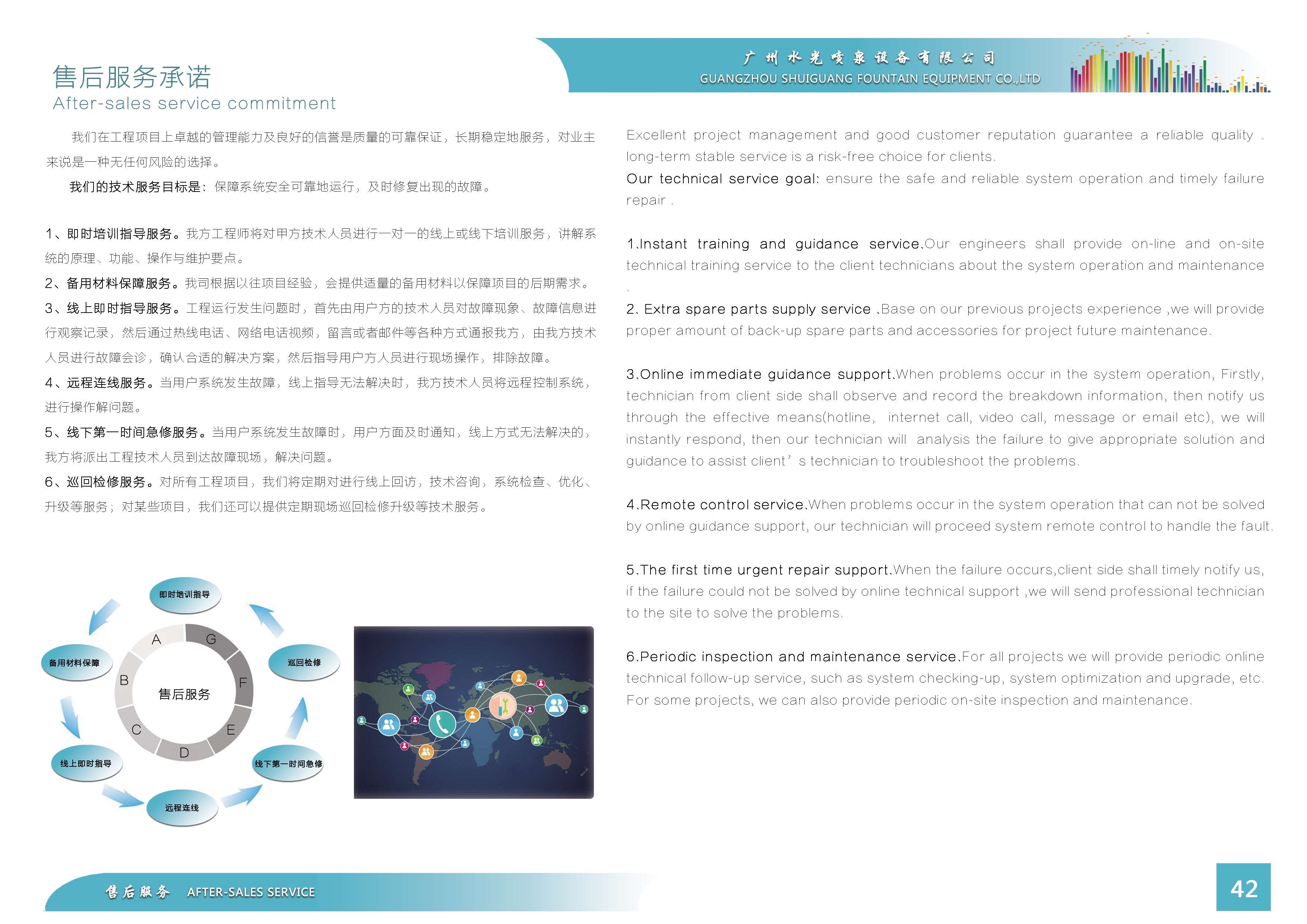
After-sales service — acceptance and maintenance contracts define responsibilities and spare-part supply.
Request the Documentation Package or a Project Quote
Rainbows Fountain — Guangzhou Shuiguang Fountain Equipment Co.,Ltd
WhatsApp / Tel: +8613631409487
Email: rainbowsfountain@163.com
Website: www.rainbowsfountain.com
Download the 2026 Rainbows Fountain brochure (PDF): 2026 Rainbows Fountain brochure
Have Questions or Need More Details?
Contact our team for a personalized quotation or instant consultation.
Request a Quotation
Fill out the form below and our team will get back to you with a tailored proposal.
WhatsApp Direct Chat
Prefer to chat in real-time? Message us on WhatsApp for instant assistance & quick answers.
- Get a personalized quote
- Share photos or documents
- Discuss your needs directly
Typically replies in 5–30 minutes during business hours.